


How to choose aluminum-wood doors and windows suitable for the European market
Aluminum-wood windows and doors, as a high-end composite product that combines the natural warmth of wood with the durability of aluminum alloy, have become a popular emerging choice in the European market, favored by developers of high-end residential, villa, and commercial projects. Driven by the EU’s carbon neutrality goals, stringent energy efficiency regulations, and the demand for high-quality living, the European aluminum-wood window and door market is steadily growing at a compound annual growth rate of 8.8%, with Europe accounting for 36.7% of the global market share, and Germany being the leading country in this market. However, choosing aluminum-wood windows and doors suitable for the European market requires attention not only to appearance and quality, but more importantly, to full compliance with local regulations, adaptation to climate characteristics, and alignment with local aesthetic preferences and usage habits. This guide will detail the core selection criteria and methods to help you choose compliant, high-performance, and competitive products.
Compliance with EU regulations and certifications is a prerequisite for entering the European market. Firstly, products must obtain CE certification according to the latest EU Building Products Regulation (CPR) and EN 14351-1:2022 standard. This certification incorporates thermal performance, safety, and fire resistance into a unified testing process, replacing the previous separate assessment model. This certification covers key performance indicators such as airtightness, watertightness, wind pressure resistance, thermal insulation, and sound insulation, ensuring the free circulation of products within the EU. For high-end projects, EPD environmental certification and carbon footprint accounting are also indispensable to meet Europe’s stringent requirements for a circular economy and low-carbon buildings. Furthermore, products must comply with local national standards, such as Germany’s EnEV standard, the UK’s Part L standard, and France’s RT standard, to successfully pass project acceptance.
High energy efficiency and excellent thermal insulation are core requirements in the European market. The EU’s Energy Efficiency Directive for Buildings (EPBD) clearly stipulates that all new buildings must meet the near-zero energy (nZEB) standard by 2030, making thermal insulation a key selection criterion. When choosing aluminum-wood windows and doors, priority should be given to thermally broken aluminum profiles equipped with PA66GF25 reinforced nylon thermal break strips. Adding a polystyrene foam insulation layer between the aluminum cladding and the wood core further enhances the thermal insulation effect, achieving a window U-value as low as 0.64 W/m²K, fully meeting the requirements of passive house projects. Low-E coated argon-filled insulated glass should be used; triple-glazed double-cavity glass is recommended in cold regions such as Northern Europe, while double-glazed insulated glass can be used in temperate regions, with a glass U-value reaching up to 0.5 W/m²K.
The selection of materials must be rigorous to meet the complex climate and environmental requirements of Europe. The inner core should be made of high-quality natural wood such as pine, spruce, larch, oak, or lauan, undergoing multiple processes including dehydration, preservative treatment, and insect prevention to avoid warping, cracking, and insect infestation under extreme climatic conditions. Laminated wood is also a superior choice, offering greater structural stability and suitability for high humidity or extremely high temperature regions. The outer aluminum cladding requires professional surface treatments such as powder coating or fluorocarbon coating, providing excellent UV resistance, corrosion resistance, and weather resistance, ensuring that it will not fade, rust, or crack even under the strong sunlight of Southern Europe or the rainy and humid conditions of Western Europe over a long period.
Hardware configuration and security performance must comply with European usage habits and stringent standards. High-end hardware fittings conforming to European standards should be selected, such as ROTO lock systems and Hoppe handles, paired with anti-pry hinges, reinforced lock bodies, and anti-theft bolts, achieving RC1 or RC2 security levels to effectively prevent unauthorized intrusion. Opening methods should primarily be casement windows and inward-opening/tilt-out windows. These opening methods are popular in European buildings due to their space-saving and easy-to-clean features. Window opening limiters and child safety locks can be added as needed to meet the usage requirements of European families. The sealing system uses multiple layers of EPDM weather-resistant rubber strips, combined with an overall isobaric sealing structure, achieving an airtightness level of 4 and a watertightness level of E1200, effectively preventing air leakage and water seepage.
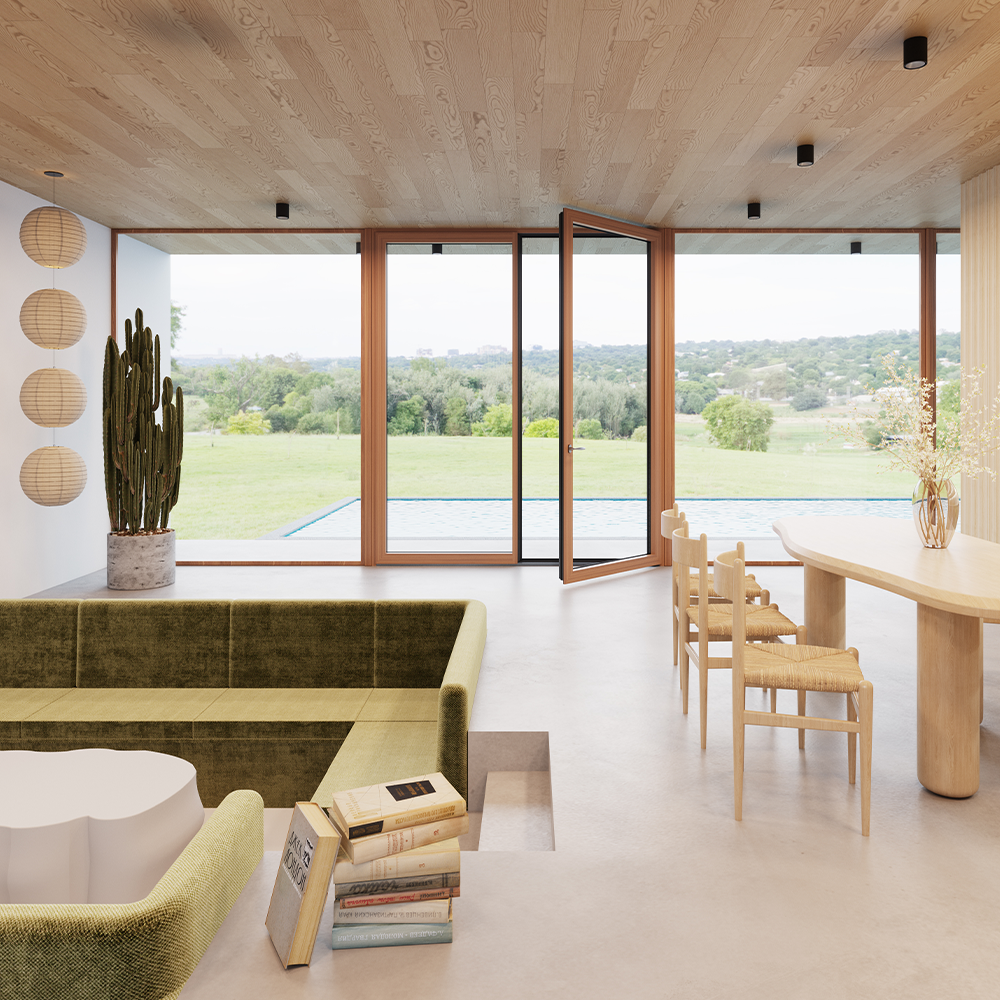
The design style should align with mainstream European aesthetics, namely simplicity, elegance, and naturalness. Prioritize ultra-narrow bezels, large fixed glass panes, and finely segmented window panes. The inner wood cladding can utilize opaque colors from the RAL color chart or a transparent coating to showcase the natural wood grain. The outer aluminum cladding can be custom-matched from a variety of color samples to match the building’s exterior color, ensuring harmony and unity with the overall architectural style. The design must perfectly adapt to various European architectural styles, from modern minimalism to European classic and pastoral styles, avoiding overly fussy decorations and highlighting the natural texture of the wood and the clean lines of the aluminum alloy.
Environmental friendliness and low maintenance are also key factors for European customers. The aluminum alloy is 100% recyclable, the inner wood should be sourced from renewable forest resources, and the production process employs environmentally friendly powder coating and fluorine-free processes, complying with EU environmental standards. The product must possess low-maintenance characteristics; the outer aluminum cladding requires no frequent painting, and the inner wood core is easy to maintain, aligning with European pursuits of long-life buildings and low maintenance costs.
In conclusion, choosing the right aluminum-wood windows and doors for the European market requires comprehensive consideration of compliance, energy efficiency, climate adaptability, material quality, safety performance, and design aesthetics. Our products fully comply with EU CPR regulations and EN standards, using high-quality materials and advanced processes. We can provide customized services based on the climate characteristics of different regions and customer needs. We are committed to providing European customers with high-end, compliant, and sustainable aluminum-wood window and door solutions, helping you establish a foothold in the rapidly growing European market and create long-term value.