


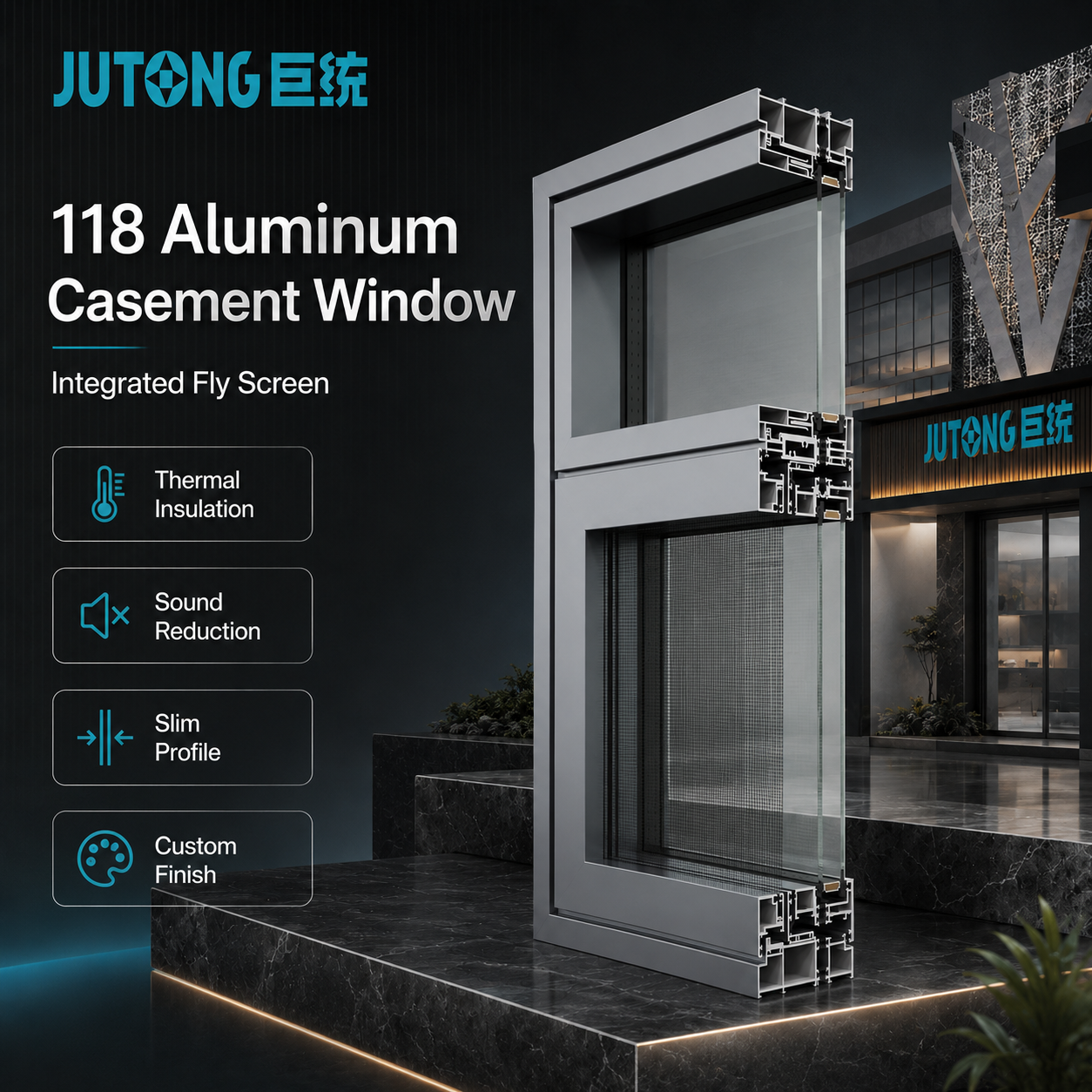
118 aluminum casement Windows
The European aluminum alloy folding and sliding windows market is in a dual cycle of steady growth and quality upgrade, playing a pivotal role in the overall European windows market and aluminum windows and doors industry. Driven by policy incentives, old house renovations, aesthetic iterations, and sustainable demands, it presents a development pattern of “sliding windows maintaining their mainstream position, folding windows experiencing rapid growth, and technology concentrating on high energy efficiency and minimalist intelligence,” becoming the core growth engine of the global window and door market.
In terms of market size, Europe accounts for approximately 30% of the global aluminum alloy window and door market, with a total market size of about €12.5 billion in 2024 for aluminum windows and doors. The compound annual growth rate (CAGR) is projected to remain at 4.5%-5% from 2025 to 2033. Bi-fold windows and doors are showing strong growth momentum, reaching a market size of US$2.01 billion in 2024, with a CAGR of 5.8% from 2025 to 2030. Aluminum alloy is the fastest-growing material in the window and door industry, with Germany showing the highest growth rate. Sliding windows, as a key category of aluminum windows and doors, maintain their mainstream market share due to their spatial adaptability and cost-effectiveness, accounting for over 50% of the residential aluminum window and door market in residential projects. High-end lift-and-slide windows, a premium type of sliding windows, are experiencing rapid penetration in countries such as Germany, Switzerland, and the UK. Additionally, tilt and turn windows, while distinct from folding and sliding types, complement the market demand in both residential and commercial buildings, further enriching the product matrix of European window manufacturers.
Policy and renovation demand are the core drivers of the windows market expansion. The EU’s Energy Efficiency Directive for Buildings (EPBD) clearly stipulates that new buildings before 2030 must meet near-zero energy consumption (nZEB) standards, and existing buildings must achieve carbon neutrality by 2050, which directly promotes the demand for energy efficient aluminum windows and doors. Local regulations such as Germany’s EnEV, France’s RT, and the UK’s Part L mandate the use of thermally broken aluminum with high-quality thermal breaks, Low-E glass, and high airtightness, accelerating the phasing out of ordinary aluminum windows. Meanwhile, over 60% of buildings in Europe are over 30 years old, and renovations account for 40%-50% of window and door demand. Folding and sliding windows, due to their ease of installation, smooth operating performance, and lack of need for significant structural alterations, have become the preferred products in the renovation market for both residential projects and commercial buildings.
Product forms exhibit a differentiated positioning and complementary development trend across residential projects and commercial buildings. Folding doors and windows focus on the high-end market, emphasizing “large opening and strong transparency,” with core applications in detached houses, high-end apartments, and commercial and leisure spaces within commercial buildings. Technically, features include multi-track ultra-thin frames, concealed hardware, low-threshold barrier-free design, and reliable thermal breaks to ensure energy efficiency. Multiple sealing strips and thermal break structures ensure excellent thermal insulation performance, with a window U-value ≤1.0 W/m²K, catering to Southern European terrace culture and Central European insulation needs. Sliding doors and windows, on the other hand, cultivate the mass market, suitable for urban apartments and small units in residential projects, divided into two main categories: economical standard sliding and high-end lift-up sliding. Narrow-frame sliding (frame width ≤30mm) offers a near-folding door visual effect and a 20%-30% lower price, giving it a cost-performance advantage; lift-up sliding can bear over 300kg, is suitable for large panes of glass, and commands a 30%-50% premium, making it the preferred high-end alternative for both residential and commercial buildings. Every window manufacturer is striving to optimize these product lines to meet diverse market demands.
Technology and design are converging, with four major trends driving the aluminum windows and doors industry upgrade. First, extreme energy efficiency: triple-glazed windows with two cavities, Low-E coating, and argon filling are becoming standard features for energy efficient products; thermal break strips in aluminum alloys are being upgraded to PA66GF25 to enhance thermal breaks performance; the U-value of windows is generally ≤0.8 W/m²K, and even ≤0.5 in passive house projects. Second, minimalist design: folding doors are becoming narrower-framed, and sliding doors are becoming wider-opening, with the difference in appearance between the two continuously shrinking; 20-40mm ultra-narrow frames and large glass windows without mullions are becoming standard features in modern architecture, both in residential projects and commercial buildings. Third, intelligent technology penetration: the penetration rate of features such as electric opening, wind and rain sensors, and APP control is expected to reach 40% by 2030, deeply integrating with the smart home ecosystem and bringing more convenient smooth operating experiences. Fourth, low-carbon throughout the entire life cycle: recycled aluminum (≥70%), a key raw material for aluminum windows and doors, fluorine-free surface treatment, and low-VOC sealants are widely used, with product carbon footprints ≤5 kgCO₂/m²; and EU EPD environmental certification has become a market entry threshold for every window manufacturer.
The competitive landscape of the European windows market is characterized by “high-end monopoly, mid-range fierce competition, and low-end penetration.” The stable supply chain of raw materials and mature production technology are key advantages of European local window manufacturers. Chinese brands are gradually entering the Eastern and Southern European markets by leveraging their cost-effectiveness and customization capabilities, but they still need to overcome compliance barriers such as CE certification and energy efficiency testing, as well as optimize their supply chain to adapt to local market needs. Additionally, the demand for energy efficient aluminum windows and doors and the emphasis on thermal breaks technology further raise the entry threshold for new players.
Looking ahead, the European aluminum alloy folding and sliding windows market, as a core segment of the global window and door industry, will continue its growth trend. Folding windows will focus on high-end and intelligent features, targeting the high-margin market in commercial buildings and high-end residential projects; sliding windows will emphasize cost-effectiveness upgrades and functional integration, consolidating their mainstream position in the mass residential market. Driven by both carbon neutrality goals and consumption upgrades, products with high energy efficiency, excellent thermal breaks performance, minimalist design, and low carbon attributes will become the core competitiveness of the market, propelling the aluminum windows and doors industry towards high-quality and sustainable development. Window manufacturers that can optimize their supply chain, control raw materials costs, and ensure smooth operating performance will gain a competitive edge in the evolving market.